
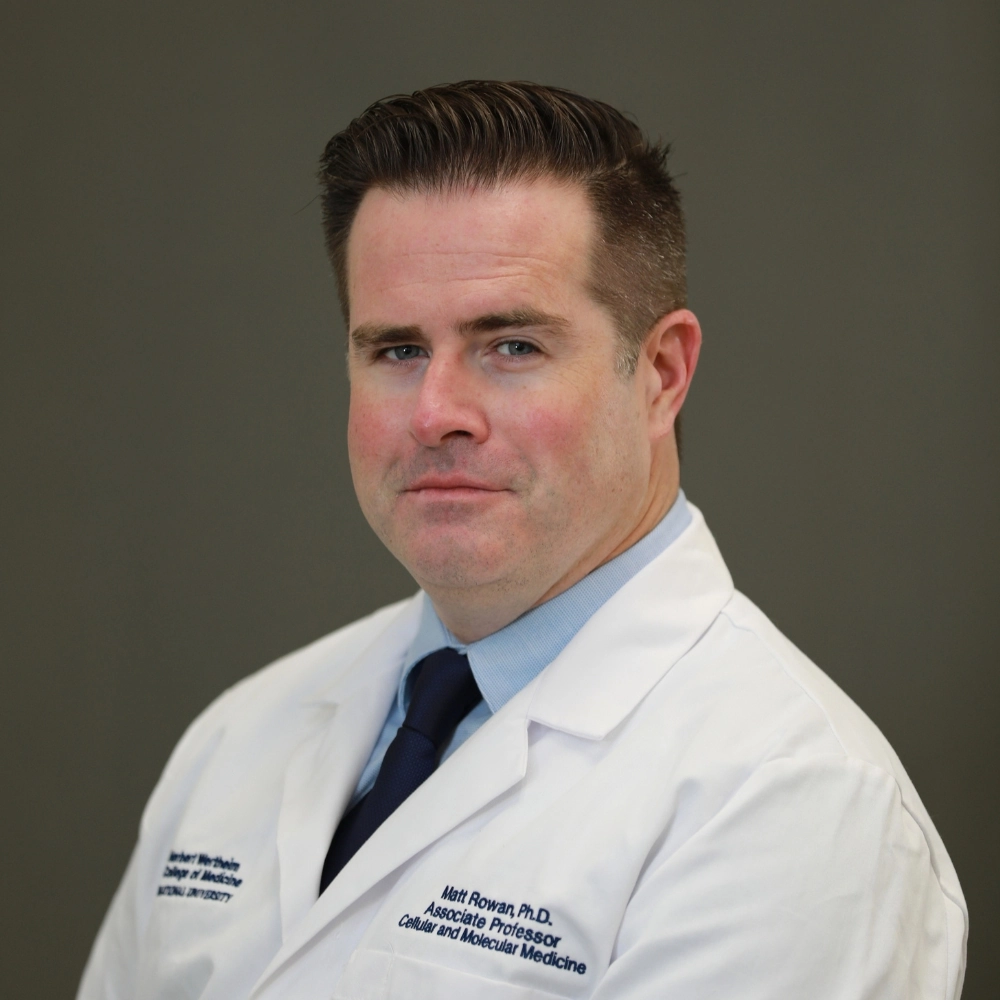
Matthew Rowan's research focuses on uncovering mechanisms that confer cellular and synaptic resilience in aging and neurodegenerative disease. His work also explores ways to unify changes at the synaptic and blood-based biomarker levels, and develop novel approaches to improve cognition across neurodegenerative and other brain diseases. The Rowan Lab combines patch-clamp electrophysiology, confocal and two-photon imaging, omics, and custom gene therapeutic tools to target and interrogate specific cell types in the brain. His research is supported by the National Institutes of Health.
Rowan provides structured training programs for faculty, postdoctoral fellows, and graduate students in advanced electrophysiology, viral delivery techniques, and high throughput neurophysiology methods. As director of the Advanced Neurotechnology Innovation Initiative, he supports the development of shared advanced imaging resources and gene therapeutic tools and methods to target specific cell populations in the brain.
Before joining FIU in 2026, Rowan completed postdoctoral training at the Max Planck Institute for Neuroscience and led a research laboratory at Emory University School of Medicine.
Areas of Expertise
- Synaptic function/physiology
- Cortical/Hippocampal/Cerebellar circuit function
- Inhibitory interneurons, the role of inhibition on plasticity
- Alzheimer's disease (AD) and AD pathology models
- Patch-clamp electrophysiology
- Cell-type-specific proteomics and targeting tools
- Advanced optical imaging, two-photon and voltage imaging
Current Grants
Project: Automated Cell-Type-Specific Electrophysiology for Understanding Circuit Dysregulation in Alzheimer's Disease
Role: Contact PI
Sponsor: NIH/NIA (R01AG079269)
Period: 08/17/2022 – 07/31/2027
Total Funding: $688,408 (FY2026)
Objectives: The overall goals of this proposal are to develop automated, cell-type-specific electrophysiology technologies that reveal how cellular and circuit dysfunction emerges in early Alzheimer's disease.
Project: Searching for the Goldilocks Zone of Innate Immunity in Alzheimer's Disease
Role: Multiple Principal Investigator with Todd Golde (contact) and Yona Levites
Sponsor: NIH/NIA (R01AG085557)
Period: 09/26/2024 – 06/30/2029
Total Funding: $1,010,081 (FY2026)
Objectives: The overall goals of this proposal are to test multiple immune manipulations, and the timing of intervention, to identify ways to harness the innate immune system for benefit in Alzheimer's disease.
Project: Understanding the Contribution of BCL11A to Neuron Function and Neurological Disease
Role: Multiple Principal Investigator with Andrew Escayg (contact) and Zhexing Wen
Sponsor: NIH/NINDS (R01NS146992)
Period: 02/01/2026 – 01/31/2031
Total Funding: $575,485 (FY2026)
Objectives: The overall goals of this proposal are to establish how BCL11A shapes human neuron development and GABAergic interneuron function, and to define how BCL11A dysfunction leads to intellectual disability, social deficits and epilepsy.
Project: Precision Targeting of Hippocampal Subfields with AAVs
Role: Contact PI
Sponsor: NIH/NIMH (R21MH142870)
Period: 03/15/2026 – 03/14/2028
Total Funding: $430,375
Objectives: The overall goals of this proposal are to develop AAV tools that precisely target hippocampal subfields, enabling studies of basic hippocampal function relevant to epilepsy and Alzheimer's disease.
Education
- Postdoctoral training, Max Planck Florida Institute for Neuroscience
- Ph.D., Integrative Biology and Neuroscience, Florida Atlantic University
- BS, Biology, University of Miami