
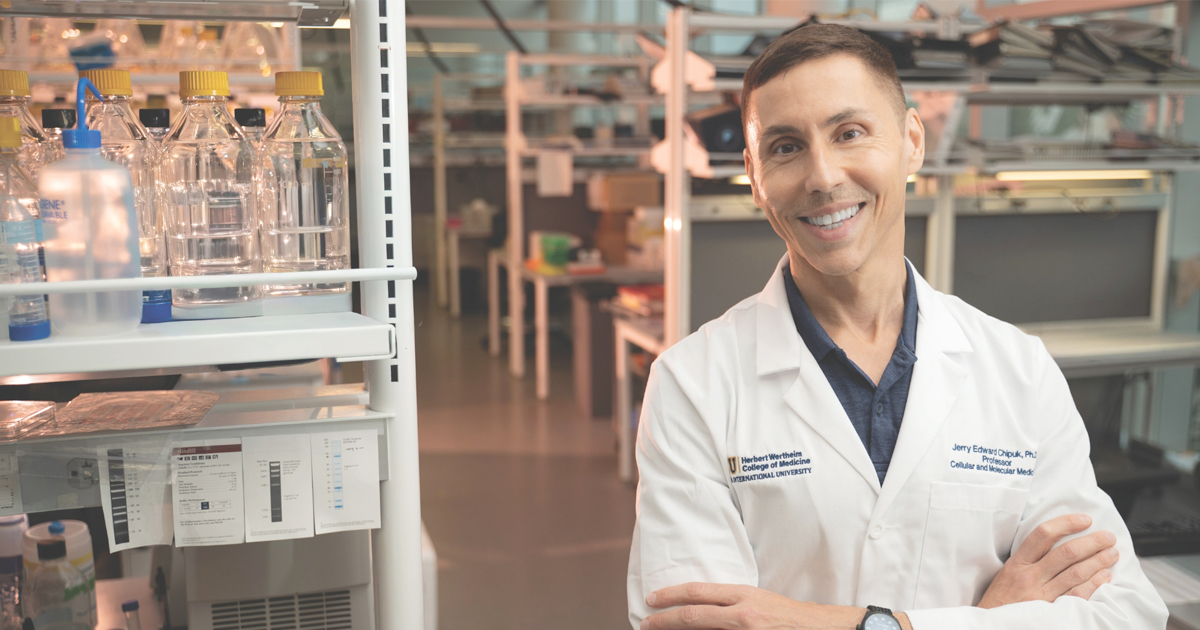
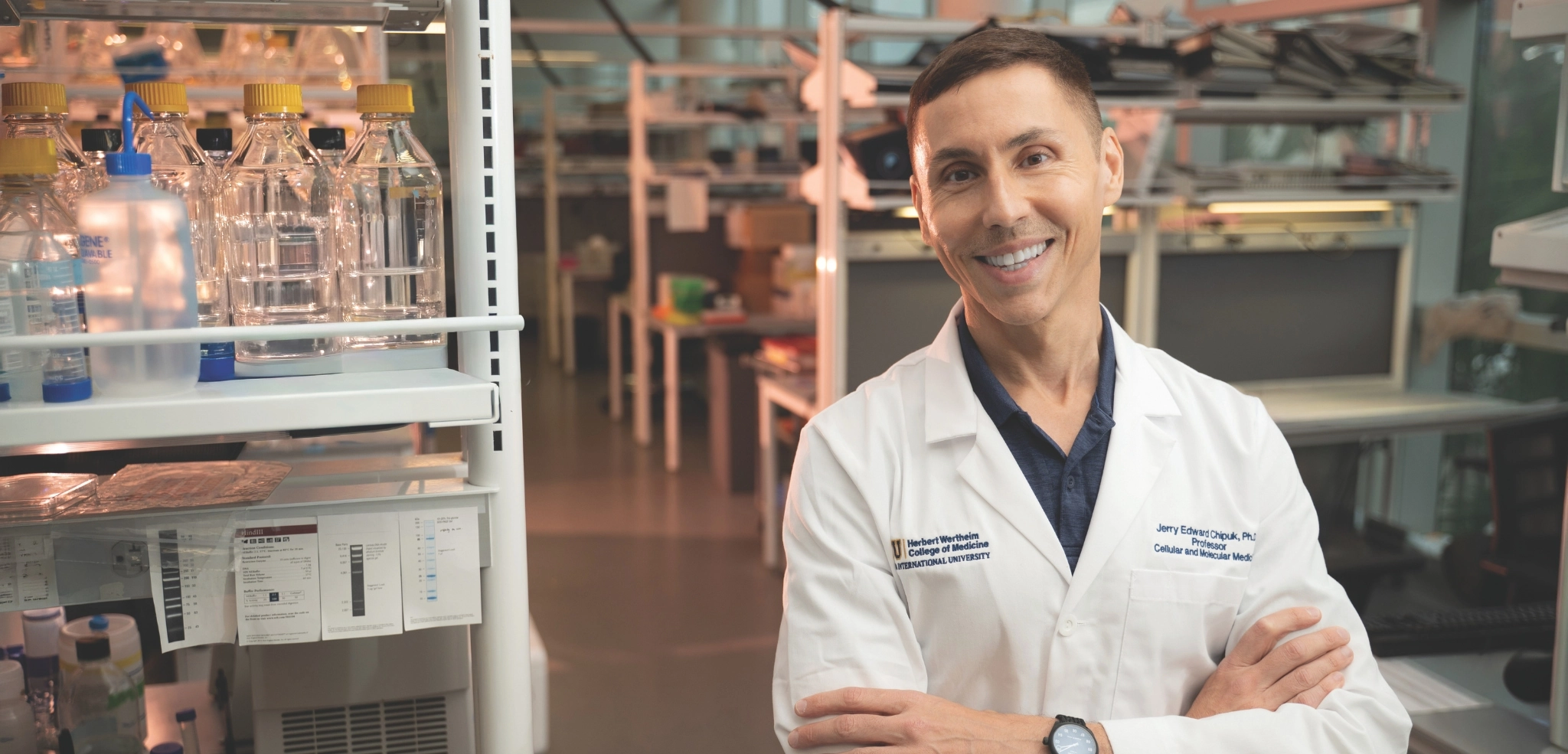
As FIU Medicine invests in the people, partnerships and infrastructure needed to accelerate biomedical discovery, Jerry Edward Chipuk, an internationally recognized expert in mitochondrial biology and cancer research, has joined FIU Medicine as chair of the Department of Cellular and Molecular Medicine. He arrives from the Icahn School of Medicine at Mount Sinai in New York City, where he spent nearly two decades helping advance one of the nation’s leading cancer centers.
“Our research enterprise is at an exciting inflection point,” said Stephen Black, associate dean for research at FIU Medicine, who served as interim chair. “With growing collaborations with our clinical partners, we are building a research ecosystem where fundamental discoveries move rapidly toward clinical application. Dr. Chipuk will be instrumental in advancing that mission.”
FIU’s research enterprise has doubled its federal funding over the past five years and plans to add more than a dozen new investigators. The hiring strategy prioritizes scientists whose work complements FIU’s clinical partners’ strengths in cancer, neurological disorders and cardiovascular disease—areas where basic insights can quickly inform patient care.
Chipuk sees the moment as transformative. “FIU’s momentum as a rapidly growing research institution creates a unique moment for the department,” he said. “Together with our faculty and trainees, we will expand our research impact, recruit outstanding investigators, and strengthen cellular and molecular medicine as a hub for discovery.”
His first priority is infrastructure. Since arriving in May, Chipuk has invested heavily in research facilities—advanced bioimaging, flow cytometry, metabolic analysis, biomarker and single-cell technologies—tailored to both existing faculty and incoming recruits. One recent hire focused on Alzheimer’s disease arrived alongside a new imaging suite designed for his work. “We’ve invested millions of dollars in the past months building this research infrastructure,” Chipuk noted. The college is also investing in physical space. FIU Medicine researchers will soon occupy an entire floor in FIU’s newly built Innovation I research facility and an additional floor in a second research building breaking ground next door.“
My goal is to build a research infrastructure that matches the caliber of FIU’s faculty—and that will recruit the next generation of top talent, positioning FIU as a leading destination for biomedical research,” Chipuk added.
Recruitment will deliberately bridge laboratory science and Baptist Health’s clinical programs. Chipuk has already met with leaders at the Baptist Health Herbert Wertheim Miami Cancer Institute and Baptist Health Miami Neuroscience Institute to identify joint opportunities. Melanoma, a focus of his own lab, offers a natural link: the disease often metastasizes to the brain, connecting cancer biology with neuroscience. Similar synergies are expected in cardiovascular research.
Chipuk’s own lab will continue probing mitochondria—the cellular powerhouses that also regulate cell death, pre-malignant changes, and metastasis. At FIU, he is advancing work on mitochondrial stress signatures detectable in skin that may predict melanoma risk, integrating metabolism, inflammation, single-cell genomics and patient samples. He plans to collaborate with the Center for Translational Science and the FIU Robert Stempel College of Public Health & Social Work to move these signatures from prognosis to potential therapies.
“My goal is to build a research infrastructure that matches the caliber of FIU’s faculty—and that will recruit the next generation of top talent, positioning FIU as a leading destination for biomedical research.”
“Understanding the fundamentals of cell biology and how those become disrupted to promote disease…mutually inform each other,” he explained. “The long-term aim spans diagnostics to treatment.”
Mentorship remains central. Chipuk has trained more than 50 scientists at various career stages and emphasizes connecting people with the right expertise rather than trying to supply every answer himself. He intends to pursue larger programmatic grants that unite multiple investigators, elevating the department’s national profile while strengthening graduate training and the broader STEM pipeline in South Florida.
The vision is pragmatic and ambitious: a world-class research infrastructure that enables neuroscientists, cancer biologists, infectious-disease experts, chemists and physicians to work side by side; strategic hires that align with clinical partners; and discoveries relevant to the diseases affecting South Florida communities.
Success, Chipuk believes, will position FIU to accelerate the translation of fundamental insights into better patient outcomes.