
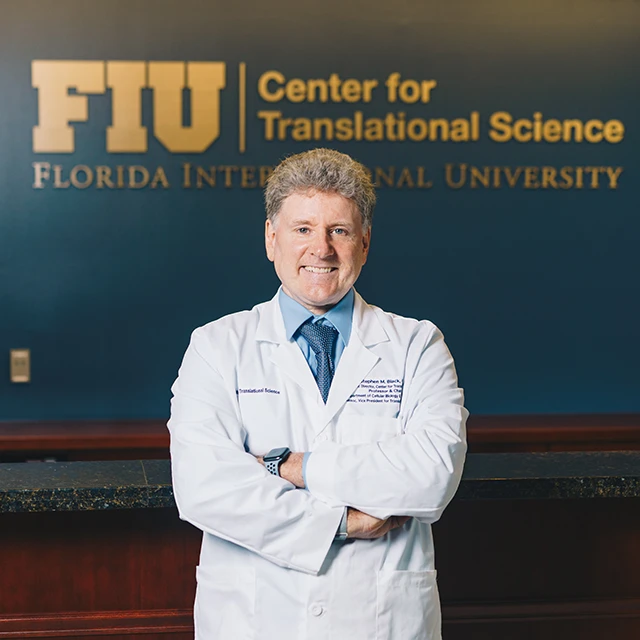
In one extraordinary week, three awards from the National Institute of Health’s National Heart, Lung, and Blood Institute affirmed the urgency and promise of Stephen Black’s work. Black, FIU Medicine’s associate dean for research, received more than $15 million to advance cardiovascular research.
Among them are two of the NIH’s most competitive awards: a P01 program project grant and an R01 research grant, underscoring both the scope and the innovation of Black’s work.
“These awards reflect not only the strength of our ideas but also the critical need for new strategies to treat devastating lung diseases,” Black says. “Each project moves us closer to translating discoveries from the bench to the bedside.”
Metabolic reprogramming and pulmonary vascular disease associated with congenital heart disease resulting in increased pulmonary blood flow
$11.4M Awarded
This P01 project explores why some children with congenital heart defects develop pulmonary vascular disease, which damages lung blood vessels. Excess blood flow to the lungs causes the vessels to adapt in harmful ways, leading to stiffness and loss of function.
The research is testing a new idea: that a gene regulator (SOX18) and a metabolic pathway producing proline (an amino acid used to build collagen) drive these damaging changes. “We’re uncovering how blood vessel cells rewire under stress,” says Black. “By understanding these triggers, we can design interventions to protect the lung’s fragile vascular system and prevent irreversible disease.”
This is Black’s fourth P01 grant, his third at FIU.
Mito-Inflammation and Sepsis-Induced Acute Lung Injury
$2.8M Awarded
This R01 award targets a deadly complication of sepsis—acute lung injury. Black’s lab previously discovered that the protein TLR4 triggers mitochondria—the “power plants inside cells—to produce excess harmful molecules called reactive oxygen species (ROS), which fuel lung inflammation.
This project builds on that work by studying how this breakdown in mitochondrial balance sustains inflammation and worsens injury. It also tests new ways to protect or restore healthy mitochondrial networks (in mice) to reduce lung damage during sepsis. The goal is to develop therapies that calm lung inflammation and improve survival in critically ill patients.
Black holds another R01 award currently investigating metabolic reprogramming of smooth muscle cells in pulmonary hypertension.
Development of Novel Rhoa Nitration Inhibitory Peptides for the Treatment of Acute Lung Injury
$1M Awarded
This project aims to develop new treatments for acute lung injury (ALI) and acute respiratory distress syndrome (ARDS)—life-threatening conditions where lung inflammation and leakage make breathing difficult. Current therapies rely on ventilation, but death rates remain high, especially with infections like COVID-19.
Black’s team previously found that a protein called RhoA, when altered by nitration, becomes overactive and disrupts the lung’s protective barrier of blood vessels, floods the lungs, damages mitochondria, and triggers runaway inflammation.
To counter this, they designed a small peptide, NipR1, that shields RhoA from nitration and protects lung function in early studies. The team now plans to create stronger, more drug-like versions of NipR1, test them in mice and pigs, and advance toward a new therapy for ALI/ARDS.
Leadership in Translational Science
A tenured professor and vascular biologist, Black plays a key role in advancing biomedical science in Florida and beyond. He oversees research at the Herbert Wertheim College of Medicine and directs the FIU Center for Translational Science in Port St. Lucie. He also serves on Florida’s Biomedical Research Advisory Council and is an MPI for the NIH-funded FIU Diversity Center for Genomic Research.
Black has spent his career studying how oxidative and nitrosative stress drive pulmonary hypertension, lung injury and stroke. His lab has been continuously funded for over 25 years, securing more than $65 million from the NIH and other major funders.