
Disease-Fighting Discovery
A team of FIU scientists is forging a path to combat two devastating conditions: Parkinson’s disease and acute lung injury. At the heart of their work is a protein called dynamin-related protein 1 (DRP1), which controls how mitochondria—the powerhouses of cells—divide and function. When DRP1 becomes overactive, it triggers harmful processes that fuel disease progression.
Researchers Kim Tieu, Stephen Black and Adel Nefzi have collaborated to develop a promising compound, CTS2444-32, that could slow Parkinson’s disease and protect lungs from life-threatening injury. Their work, fueled by FIU’s collaborative spirit and robust resources, offers a beacon of hope for patients facing these debilitating conditions.
Tieu, a professor of environmental health sciences at FIU Stempel College, has spent years studying DRP1’s role in Parkinson’s, a disease marked by tremors, stiffness and the loss of brain cells.
“DRP1 controls mitochondrial division,” Tieu explains. “When it’s overactive, it causes excessive splitting, leading to cell death and inflammation that drive Parkinson’s progression.”
Tieu’s lab developed a high-throughput assay to screen compounds that tame DRP1’s activity, initially partnering with University of Florida-Scripps Institute Molecular Screening Center to test FDA-approved drugs. A subsequent connection with FIU Center for Translational Science (CTS) sparked a breakthrough. Black, CTS director and associate dean for research at the College of Medicine and an expert in acute lung injury, discovered that DRP1’s overactivity also drives damage in conditions like sepsis and ventilator-induced lung injury (VILI), where lungs fill with fluid, endangering lives.
“In our models, DRP1 triggers mitochondrial dysfunction, releasing harmful reactive oxygen species that cause inflammation and tissue damage,” Black says.
Recognizing their shared target, Tieu and Black teamed up, leveraging FIU’s resources to identify a novel compound. Nefzi, a medicinal chemist at the College of Medicine, provided a critical piece.
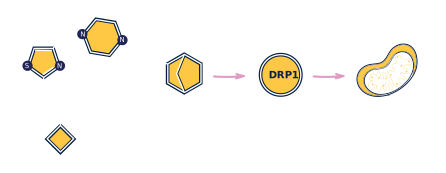
“Our 35-million-compound library allowed us to screen and identify CTS2444-32, a potent DRP1 inhibitor with a unique chemical structure designed for precision,” Nefzi says.
Their collaboration yielded CTS2444-32, a compound that inhibits DRP1 by up to 45%, as shown in preclinical tests. In Tieu’s Parkinson’s models, it reduced neuroinflammation and the buildup of toxic proteins like alpha-synuclein, a hallmark of the disease.
“This isn’t just symptom relief like current treatments, which only replace missing chemicals,” Tieu says. “CTS2444-32 is potentially disease-modifying, protecting brain cells and slowing Parkinson’s progression.”
In Black’s lung injury models, CTS2444-32 significantly reduced inflammation and oxidative stress, protecting mice from VILI within 24 hours.
“We saw reduced levels of inflammatory molecules in lung fluid, showing the compound’s ability to stabilize mitochondria and prevent damage,” Black says. “We tested a drug in animals in under a month—that’s lightning speed.”
Nefzi highlights the compound’s versatility: “CTS2444-32 targets multiple disease pathways with a single drug, offering hope for conditions beyond Parkinson’s and lung injury, such as Alzheimer’s, heart disease and even certain cancers.”
The team was awarded a patent for the compound. They note its potential to treat neurodegenerative diseases, cardiovascular disorders and cancers by addressing mitochondrial dysfunction, oxidative stress and autophagy impairments.
FIU’s collaborative environment and resources, including its patent office, made the development and patenting of CTS2444-32 possible.
“FIU breaks down silos,” Black says. “We had experts in drug screening, chemistry and animal models working seamlessly.” Tieu adds, “The patent office and access to a vast compound library were game-changers.”
The team is now refining CTS2444-32, testing derivatives to improve solubility and bioavailability for human use. Black anticipates a paper on lung injury findings within six months, with clinical trials possibly a year away.
The researchers are also scaling up to large animal models, like pigs, to meet FDA requirements for clinical trials.
FIU’s vision fuels this progress, with NIH funding doubling to $12 million annually and a goal of $30 million by 2030.
“We’re training the next generation to build a biotech hub in South Florida,” Black says, emphasizing the local impact.
For patients, CTS2444-32 offers hope. Parkinson’s patients could experience slower disease progression, while those in intensive care with acute lung injury might survive conditions with 30-40% mortality rates, such as acute respiratory distress syndrome.
“Seeing a compound move from the lab to potential treatment is why I do this,” Tieu says.
Black agrees. “This is about saving lives.”