

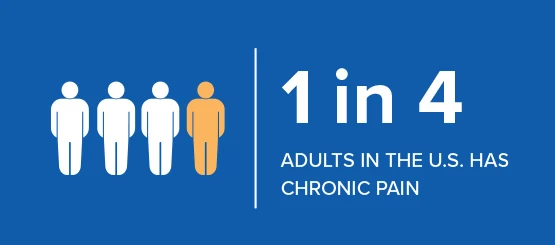
In the bustling labs of the Herbert Wertheim College of Medicine, a quiet revolution is underway to ease the suffering of millions.
Led by Dr. Saurabh Aggarwal and Dr. Patricia Junquera, two groundbreaking clinical studies are tackling chronic pain’s mysteries. The researchers’ work offers hope for safer, opioid-free solutions.
Unraveling Pain in HIV Patients
The first study, NIH-funded, dives into the molecular roots of chronic pain in HIV patients. Aggarwal, a tenured associate professor and translational researcher at the Herbert Wertheim College of Medicine, says, “Almost 80% of people with HIV experience chronic pain.” He notes the figure climbs to 87% locally. “Nothing helps them.” Opioids, often the go-to treatment, carry risks of addiction and fuel the opioid crisis.
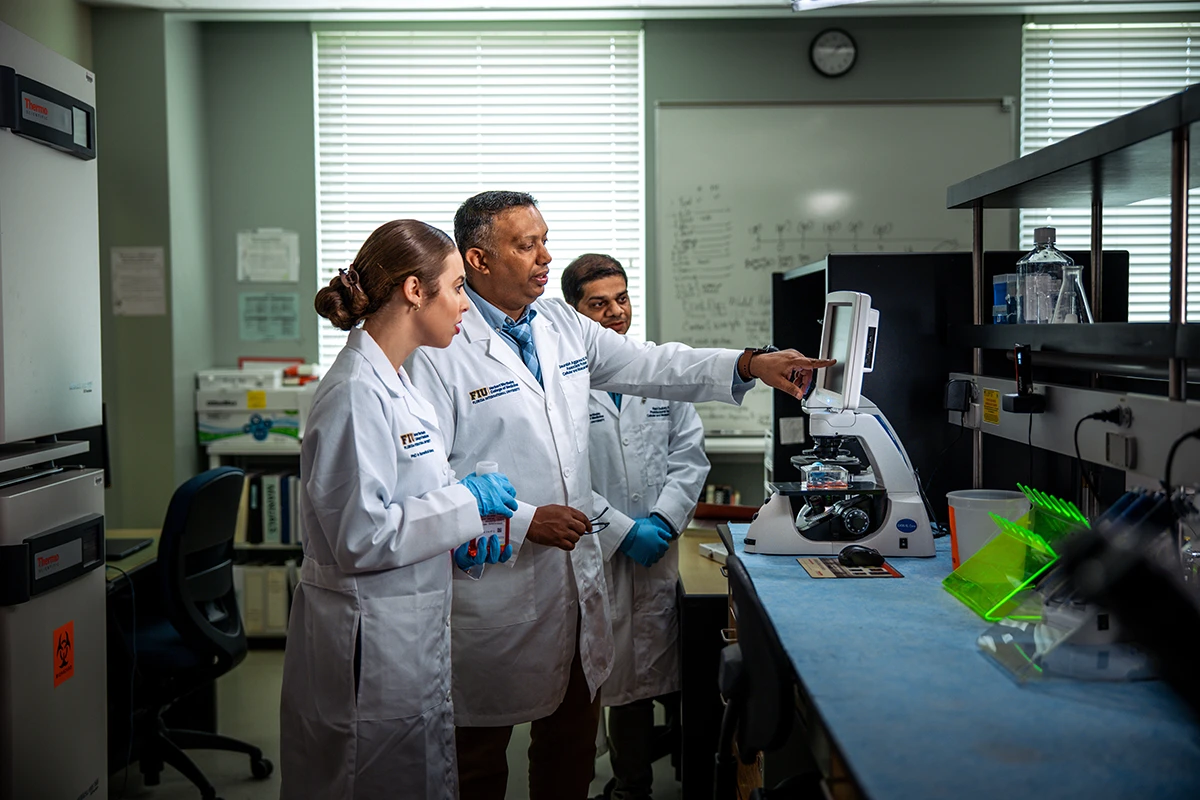
Aggarwal aims to understand why these patients suffer widespread pain—described as a full-body malaise rather than localized aches. Their research has uncovered a key clue: HIV patients with chronic pain have drastically low levels of beta-endorphins, the body’s natural painkillers.
“If a healthy person has 100 molecules of endorphins, these patients might have 25,” Aggarwal explains. “Their bodies don’t produce enough, so they feel constant pain.”
To explore this, the study is recruiting 200 patients across four groups: HIV-positive and negative, with and without chronic pain. Nearly 100 are enrolled, with blood samples analyzed for pain markers like cytokines and beta-endorphins.
A unique approach tests pain response using methylnaltrexone bromide, an FDA-approved drug for opioid-induced constipation. By blocking mu-opioid receptors, it reveals whether low endorphin levels drive pain. “In healthy people, blocking these receptors increases pain,” Aggarwal says. “In HIV patients with low endorphins, pain stays the same—proof their natural pain relief is deficient.” The goal? Develop drugs that boost endogenous opioids, reducing reliance on addictive fentanyl or morphine.
Transcutaneous Magnetic Stimulation for Pain
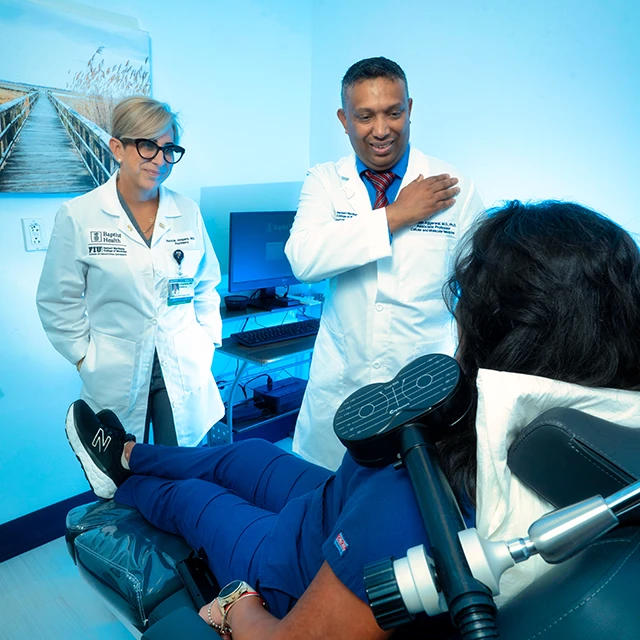
Dr. Patricia Junquera and Dr. Saurabh Aggarwal in the TMS treatment room.
The second study, in collaboration with Baptist Health, explores transcutaneous magnetic stimulation (TMS) to relieve post- traumatic and post-surgical chronic pain. TMS uses focused magnetic pulses to stimulate specific areas, traditionally for treating depression, OCD and migraines resistant to medication or therapy.
Recently, the FDA cleared the MagVenture TMS device—the only device approved for transdermal magnetic stimulation—for peripheral pain. However, its pain-relief mechanisms remain unclear. Junquera, chair of College of Medicine, psychiatry and behavioral health at the and Aggarwal are working to change that.
As a geriatric psychiatrist treating patients over 60, Junquera frequently encounters comorbid pain conditions like osteoarthritis, low back pain or migraines.
“A lot of my patients have comorbid pain conditions,” she says. “Sometimes you can’t figure out what came first—the pain causing depression or anxiety, or the mental health issues exacerbating the pain.”
Junquera’s experience with TMS for depression sparked her involvement.
“This machine I used for depression just got cleared for peripheral pain,” she recalls telling Aggarwal. “I said, ‘Wouldn’t it be interesting if we can treat pain with this machine? It’s much shorter than for depression—four to five sessions of 30 minutes, compared to 36 treatments of 19 minutes for depression.”
With a $7.5 million grant from the NIH, the team partnered with Dr. Eduardo Icaza, a comprehensive and interventional pain management physician at Baptist Health Miami Neuroscience Institute. Together, they’re conducting a pilot study, with 20 patients enrolled, aiming for 50 by mid-2026.
The study targets a diverse group, including middle-aged patients with low back pain, osteoarthritis or injuries. Over four days, patients receive 30-minute TMS sessions targeting pain sites, such as the shoulder or knee. Before and after, researchers measure pain levels, anxiety, depression, vascular function, glucose levels and inflammation markers like endorphins and cytokines.
“Eighty percent of patients show reduced pain after TMS,” Aggarwal says. “Their blood vessels dilate, producing more nitric oxide, which improves oxygen delivery to tissues.”
Junquera emphasizes the broader implications: “What causes pain is inflammation. If we’re not treating the inflammation, how are we helping these people? TMS offers a non-addictive alternative, reducing suffering and improving well-being without relying on pills.”
This suggests TMS counters central sensitization, where the body fails to produce enough pain-fighting molecules. The team presented preliminary data at the FIU-Baptist Health Research Symposium in September and has applied for a five-year NIH grant to further explore TMS’s impact on pain, inflammation, glucose levels and related conditions like heart disease and diabetes.
A Cooperative Environment
Both studies benefit from FIU’s collaborative spirit.
“FIU offers a highly collaborative environment,” Aggarwal says. “In 15 months, we’ve enrolled nearly 100 patients for the HIV study—a huge leap from my time in Alabama, where we managed 15-20.”
Partnerships with Baptist Health and the Miami Center for AIDS Research, which connects researchers to 10,000-12,000 HIV patients, accelerate progress. Leaders like Stephen Black, associate dean for research at the College of Medicine, and Christopher Grayson, FIU’s director of research integrity, have been instrumental.
“Their enthusiasm is infectious,” Aggarwal notes. “They hold your hand, pushing you forward.”
Junquera echoes the collaborative ethos: “Working with Baptist Health and Dr. Icaza allowed us to create a protocol that mimics the FDA clearance but digs deeper into how TMS works for pain.”
Aggarwal’s vision for 2030 is bold: a drug that boosts natural endorphins, slashing opioid use.
Junquera shares this optimism, advocating for non-addictive solutions. “We’ve created a generation of addiction with pills. We need to think outside the box for pain and mental health, reducing stigma and suffering.”
By unraveling pain’s mechanisms—whether in HIV, cancer or fibromyalgia—FIU’s research, amplified by its Baptist Health partnership, could transform lives. For patients trapped in the grip of pain, Aggarwal and Junquera’s work is a beacon of hope, proving South Florida’s collaborative spirit can change medicine.